3.1 Explain the importance of teamwork when working on a film production
In our production, between five of us we have a director, producer, cinematographer, screenwriter, editor, sound person and two actors. Our team worked together to prepare for the shoot by making the planning stage a really collaborative process with all of us sharing our ideas. This was the exact same on the day where we all had to collaborate so that we could film the best possible footage. At times, all of our roles would intertwine. If we completely, left each person to do their job individually lots of mistakes could occur. In certain moments critique or a different opinion is what is needed to allow the film to move forward. In post production again every decision we made was discussed as a team so that we could end up with the best finished version of our film. If production teams don’t work well together, it will create a negative mood on set. This will affect everyone’s mood on set and people may be afraid to speak up. This could lead to great ideas not being suggested and the key creative people on the film not collaborating successfully which will only be of detriment to the film. A negative mood on set could affect the actor’s performances as well because they don’t feel comfortable which again is only going to affect the film negatively.
One way in which we worked well together was there were times when everyone would have a say on the angle and shot type we should use. There were other times when everyone would have a say bar the people that were in the shot of the camera. In this environment it is only of benefit to the film because lots of different points of view are being put across. Without good teamwork problems can remain unresolved or not solved in the best way possible. This is when good team work is most important when something isn’t working because if you have a set where people aren’t getting along, when a problem arises people will naturally look to solve the problem as quick as possible with little fuss however the best solution could be one that lots of time is needed to come to. An example of when teamwork could have been better on our production was right at the start when we had barely shot any scenes for a period of time when really we should have due to the tight time constraints we were under. This was because we were being to undeceive with decisions such as what we should shoot first. What to shoot first caused us great confusion as where the majority of our filming took place, there was another group which we were not aware would be there with us. They were only there however for a few hours, whereas the majority of our production took place in this same location. It presented us with a headache because we didn’t want to hear there filming in ours.In the end we shot the shots first where there would be voice over as we would be putting sound over the shots anyway. Once we had got into the groove of filming it was not an issue at all.
Perhaps the difficulty we had experienced at the start was inevitable for a bunch of first time filmmakers who had no experience of what it is like on a set. Our shoot day would have run smoother if we had a shot list with us that featured in what order, we would film all of the different shots for the day. This would have saved us from some of the periods of indecisiveness we faced. We had a shot list that had on it all of the different shot types we would use, however not the running order in which we would film then. It is the producers job to ensure filming is on track to meet it’s schedule.
3.2 Identify the qualities needed to work well with others
Two of the most important qualities for working well as part of a film production are good team work and good communication. These skills are vitally important because without good collaboration on a set the day to day running of the set will not run as smoothly and creatively great ideas may not be suggested if all of the people on a set aren’t collaborating as they should be. Communication is vitally important as well to ensure that everyone on the set is clear what they are doing on a day to day basis. Being reliable and having good time keeping are two other vital skills. When a film is under a tight schedule which inevitably creates a high pressure environment, everybody on a set needs to know that they can rely and trust everybody on it. If people don’t show up on time, valuable filming time could have been lost or time creating a prop. In a high pressured environment where there may be a deadline of which the production must be finished or a certain actor may only be on set for a period of time, no time can be wasted due to how precious it is. This is why being hardworking is an important quality needed as part of a production team as due to the time constraints, most shoots will have long filming days. The people needed on set are those that are reliable and hardworking so production staff can know that all of them can fulfil their roles and responsibilities successfully for potentially 12 hours a day. Also sharing ideas is an incredibly important quality to have in a production team. A great idea can elevate a film therefore if anyone has good ideas, they should definitely be shared. If a production team is full of people who puts ideas forward, this will only be of huge benefit to the film.
In the production process for my film, I showed good timekeeping because whenever I was needed in the production process, I always was there on time and ready to collaborate. I was reliable as well as I have not missed one session of the academy. Before the filming day once we had an idea in place that we had all agreed upon to do, I was constantly suggesting ideas what I felt would work well in our film. This included the ending to our film where one of the characters dies, blood pours out of their mouth. I have demonstrated good communication as well throughout. I have demonstrated this all of the way through production by bouncing ideas around with my group and when we were planning the film as well as on the shoot day. In the editing room, I worked closely with the editor to edit our film and I showed good communication skills on the edit day as me and Michael, our groups needed to constantly share our opinions with each other. Me and my group demonstrated safe working as we had a risk assessment created by our producer, Constance. The risk assessment we created was successfully adhered to on the shoot day.
3.3 Describe how you worked with others collaboratively on your film production
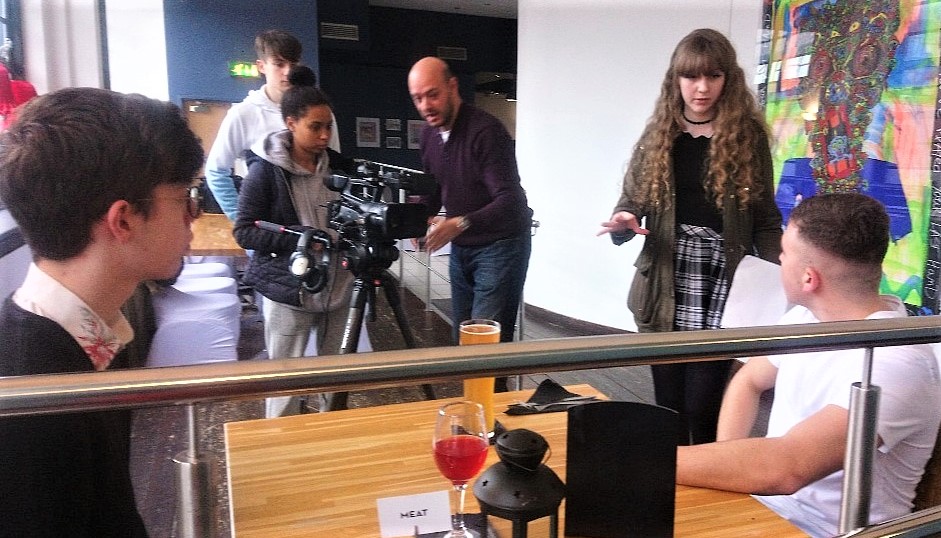
I worked well with my production team I believe as I was in constant communication with them all of the way through production. We created a snapchat group where we were constantly in communication with each other and ideas were even suggested in it. We worked very well I thought in the creative process where once we had the idea for our film set in stone, lots of ideas were being suggested. We all made suggestions for the script and we worked well on the day where we were planning the shoot day. On this day, two of our group wasn’t present and we needed to plan what shots we were going to use. We as a group had to be decisive despite missing members of our team because we were aware of how precious time is on the shoot day. We were slow in getting started filming, however once we got going we worked well together. Constance seemed to take a lead on directing at times when I was being filmed and we all at different points shared our thoughts on where the camera should be positioned. The edit day was a day when we worked well together. Throughout the day me and Michael who was our editor worked closely together and the rest of our group created credits and picked suitable music for our film that was copyright free. At various points in the day, we would ask the remainder of our group for their opinion on a part of our film we were editing.
On the shoot day, as I mentioned earlier, one problem we had to overcome was that at the start of the shoot day, we were being too indecisive about in what order we should film the script. The main reason for this indecisiveness was that in the space where we were filming, we were not aware another group was filming in there. We was filming in this space for most of the day, however fortunately the other group was only filming in there for a few hours. This still though presented us with the problem of in what order should we film the story. With some prompt by Rob Speranza, a local director and producer who was assisting us for the day, who told us we were wasting valuable time, we soon got the ball rolling. Once we had found a rhythm, that was it, we had no more long interruptions for the rest of the day. The other major problem we had to overcome in production was in the edit day when there was a line that we could not keep in the film as it broke BFI guidelines. The line was spoken in French and would have been translated in English with the use of a subtitle. We recorded a new line however couldn’t get it to work with the footage we had recorded. The reason it wouldn’t work was because the old spoken line was longer than the new one therefore Dillon’s mouth would have been open for longer than there was voice heard. This was a problem that right up until the end of the edit day, me and my group were trying to resolve, in the end the best solution we felt was leaving it out because we thought it would have made the scene looking muddled and not natural. I can continue to improve my ability to work with others by after the course has finished, carrying on filming films. This would also give me more experience of what it is like on a set and the common problems that are experienced on set. It would also give me more opportunities to put into practice what I have learned at the academy.
 Josh Allott Director's Blog
Hi Josh,
Thanks for this. You’ve clearly given great consideration to the effectiveness of your team and how you could improve upon communication.
In 3.1, teamwork section, under working relationships: although I personally love your use of the phrase ‘bad vibe’ I would change this to ‘atmosphere’ or ‘environment’ for the purposes of professionalism. This is a blog that you can use to show to future employer to demonstrate the development of your skills.
Spelling – undecisive
Grammar- we didnt want to hear there filming
You talk about ‘being unsure what to shoot first’ as a sticking point? What documents could you produce next time to ensure this doesn’t happen? Whose responsibility should it be to ensure everything runs to schedule?
Also, please paragraph this section to break it up a bit to make it more accessible for the external moderators.
LikeLike
Hi Josh,
Thank you for working on this section on your portfolio. You have evaluated the importance of team work when working on film productions and discussed the impact of collaborating on creative projects. You have identified qualities needed to work with others on a film production and the consequences of poor communication skills. This module is now completed to a high level, well done.
LikeLike